Welcome to Tajerin Trading Company



Address:
Etesami St, Ziba Shahr, Bandar Abbas
Whatsapp:
Email:
info@tajerin.com

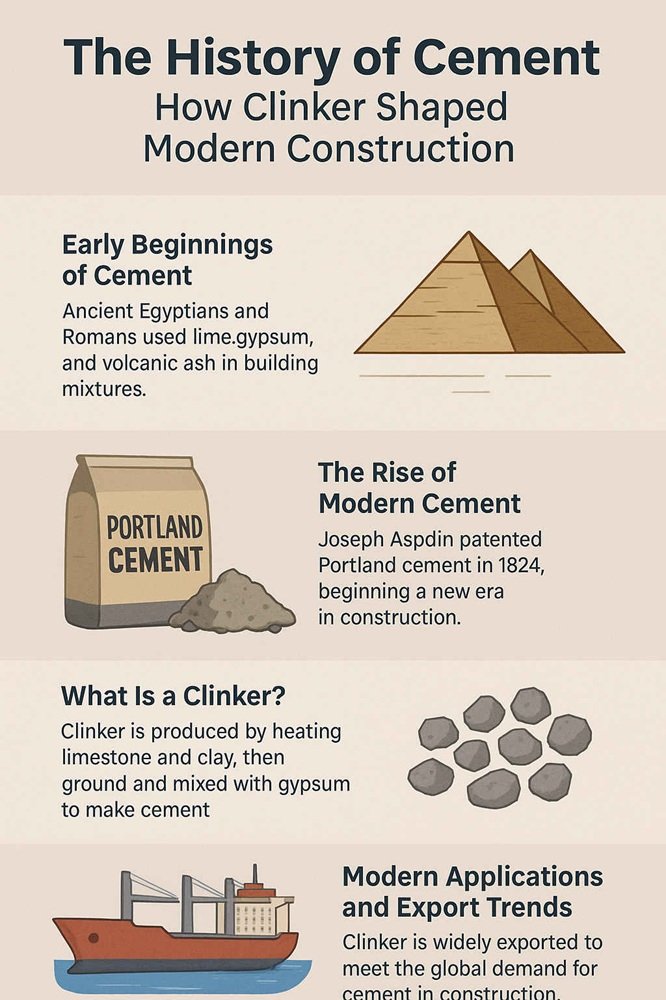
The history of cement stretches back thousands of years, long before modern cement plants, rotary kilns, and bulk clinker shipments existed.
Early builders discovered that certain burned and finely ground materials could react with water and form durable binders. Over time, these simple materials developed into increasingly sophisticated construction products. Eventually, industrial production methods transformed cement from a local building material into one of the foundations of modern infrastructure.
However, the most important change came when manufacturers learned how to produce cement clinker consistently at high temperatures. That development made large-scale Portland cement production possible and helped shape the modern cement industry.
Today, clinker remains the key intermediate material used in the production of most Portland-based cements. Therefore, understanding the history of cement also means understanding how clinker changed the way cement could be manufactured, transported, and supplied around the world.
The earliest forms of cement were very different from the product used today.
Ancient builders used materials such as:
For example, Roman builders combined lime with volcanic ash to create hydraulic binders that could harden even in wet conditions.
As a result, Roman engineers were able to construct harbors, bridges, aqueducts, baths, and other structures that demonstrated remarkable durability.
However, these early materials were not Portland cement. They were predecessors that showed an important principle: carefully selected mineral materials could react together and create strong binding systems.
For many centuries, lime remained one of the most common construction binders.
Builders produced lime by heating limestone and then mixing the resulting material with water. Although useful, traditional lime mortars generally hardened more slowly than modern hydraulic cements.
Gradually, manufacturers began experimenting with mixtures of limestone and clay.
These mixtures behaved differently because the clay introduced silica and alumina into the system. Consequently, the burned product could develop hydraulic properties, allowing it to harden more effectively in the presence of water.
This development marked an important step in the history of cement.
A major turning point came in the early nineteenth century.
Joseph Aspdin, an English bricklayer, patented a material called Portland cement in 1824. He used the name because the hardened product resembled Portland stone, a well-known building stone in England. The American Cement Association also identifies Aspdin’s work as an early foundation of modern Portland cement production. American Cement Association
Nevertheless, early Portland cement was not identical to the modern product.
During the nineteenth century, manufacturers improved kiln temperatures and burning methods. As production technology developed, stronger heating allowed the raw materials to react more completely.
Eventually, manufacturers began producing the hard, nodular material that we now recognize as clinker.
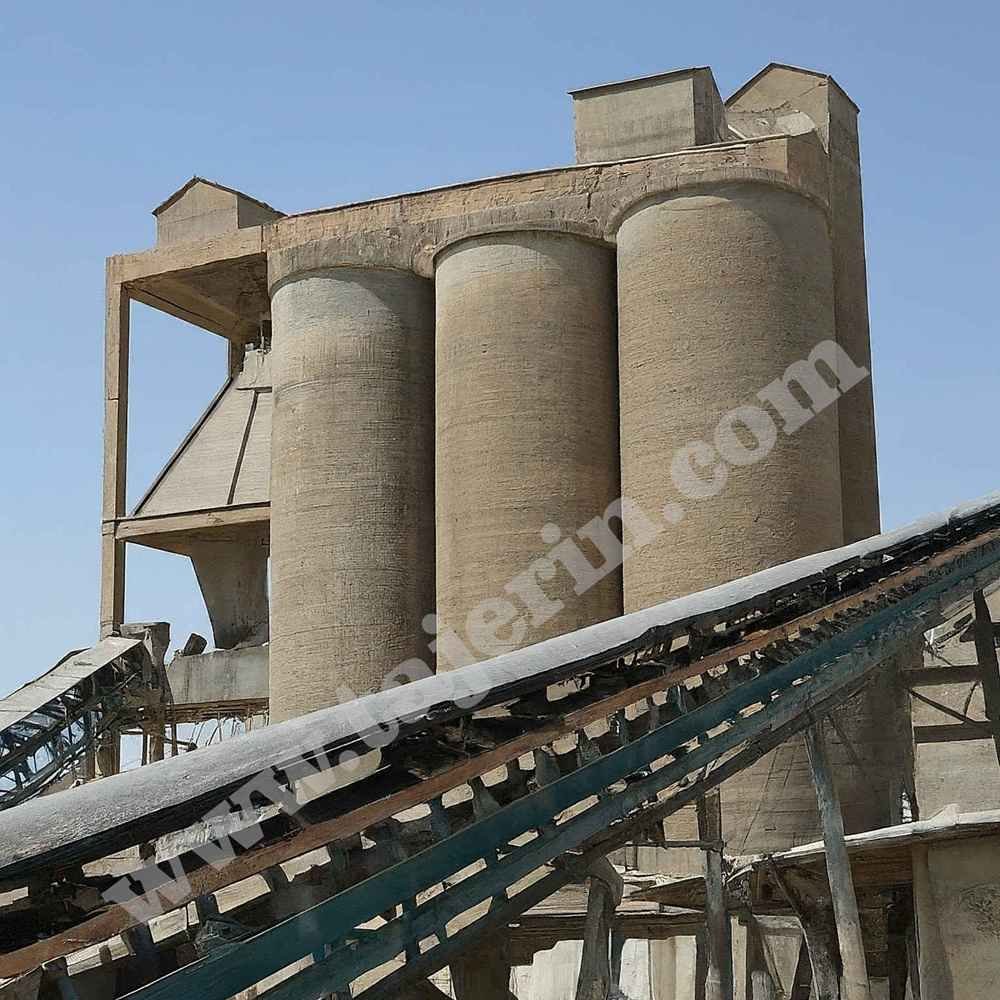
The emergence of clinker was a major industrial breakthrough.
Instead of simply burning limestone or producing relatively soft hydraulic materials, cement manufacturers could now heat carefully proportioned raw materials at very high temperatures.
During this process, calcium, silica, alumina, and iron compounds react inside the kiln and form new mineral phases.
The result is clinker: a hard intermediate material that can later be cooled, stored, transported, and ground into cement.
Therefore, clinker created a practical separation between two major stages:
Clinker production → Cement grinding
This separation eventually became commercially important because clinker could be produced in one location and ground into cement somewhere else.
Modern clinker production begins with carefully selected raw materials.
The main ingredients generally provide:
Limestone usually provides most of the calcium, while clay, shale, sand, iron-bearing materials, or other corrective materials help achieve the required chemical balance.
First, producers crush and prepare the raw materials.
Next, they grind and blend the materials into a more uniform feed.
Then, the prepared material enters a preheater and rotary kiln.
Inside the kiln, temperatures become high enough to drive complex chemical reactions. Eventually, the material partially melts and forms clinker nodules.
According to the American Cement Association, clinker forms during high-temperature kiln processing and is later cooled before final grinding.
Clinker is not normally the final product sold for direct use in concrete.
Instead, cement manufacturers grind clinker into a fine powder and combine it with controlled amounts of gypsum and, depending on the cement type, other permitted materials.
As a result, the finished product becomes cement.
In simple terms:
Raw materials → Kiln → Clinker → Grinding → Cement
This distinction is important because clinker and cement serve different roles in the supply chain.
Clinker is the intermediate product.
Cement is the finished binder used in construction.
For a more detailed technical explanation, buyers can read our guide to what cement clinker is and how its composition affects cement production.
As industrialization accelerated in the nineteenth and twentieth centuries, cement production expanded rapidly.
Better kilns improved temperature control.
Mechanized crushing and grinding increased production capacity.
Railways and ports made heavy mineral materials easier to transport.
Meanwhile, laboratory testing improved consistency and quality control.
Consequently, cement manufacturers could supply increasingly large infrastructure projects.
Cement became essential for:
The industrial production of clinker played a central role in this expansion.
As the cement industry developed, not every market needed to operate a complete integrated cement plant.
Some countries had strong limestone resources and efficient clinker production.
Other markets had growing cement demand but limited kiln capacity.
Therefore, international clinker trade became commercially useful.
A grinding plant could import bulk clinker and then produce cement closer to its local market.
This model can be attractive when:
As a result, clinker became not only an industrial material but also an important internationally traded commodity.
As clinker trade expanded, the role of the clinker supplier also became more important.
A bulk buyer usually needs more than a product description.
Before purchasing, the buyer may need to evaluate:
Therefore, a reliable clinker supplier should help the buyer evaluate the complete commercial arrangement rather than focusing only on the price per metric ton.
For buyers sourcing internationally, the final decision should consider both clinker quality and logistics.
The industrial success of cement also depended on improved quality control.
Modern cement plants monitor clinker chemistry carefully because its mineral composition affects the performance of the final cement.
Important clinker compounds commonly include:
These phases influence characteristics such as strength development, setting behavior, heat generation, and sulfate resistance.
Therefore, clinker quality cannot be judged only by appearance.
Laboratory analysis is much more important.
Buyers who want a deeper technical explanation can review our clinker quality analysis guide.
During the twentieth century, cement became one of the most important materials in modern construction.
Rapid urbanization created demand for:
Because concrete depends on cement as its binding component, increasing construction activity also increased demand for cement production.
In turn, that growth increased the importance of reliable clinker production.
Therefore, clinker became a strategic material within the global cement supply chain.
The terms cement and concrete are sometimes used as if they mean the same thing.
However, they are different materials.
Cement is a binder.
Concrete typically combines:
When cement reacts with water, it binds the aggregates together and forms hardened concrete.
The American Cement Association describes cement as a key ingredient in concrete rather than the finished concrete itself.
This distinction is important when discussing the history of cement, because cement development directly influenced the expansion of concrete construction.

Modern clinker plants operate very differently from early cement works.
Today, producers use:
As a result, plants can maintain more consistent production while using energy more efficiently than earlier generations of cement factories.
However, clinker production remains the most energy-intensive stage of cement manufacturing. For this reason, the cement industry continues to invest in efficiency improvements and lower-carbon production methods.
The next chapter in the history of cement is increasingly connected to sustainability.
Cement producers are working to reduce the environmental impact of manufacturing while maintaining performance and durability.
One approach involves reducing the clinker-to-cement ratio by using suitable supplementary materials.
Another approach focuses on improving kiln efficiency.
In addition, manufacturers are exploring:
Nevertheless, clinker remains central to the production of conventional Portland-based cement.
Therefore, changes in clinker production will continue to influence the future of the cement industry.
The history of cement is not only an academic subject.
It also explains why today’s cement supply chain is structured the way it is.
Modern buyers can source clinker from one market, transport it by sea, and grind it into cement in another country.
That commercial model became possible because clinker can serve as a stable intermediate product between kiln production and final cement grinding.
For bulk buyers, this creates flexibility.
However, successful sourcing still depends on several factors:
Therefore, historical development and modern trade are closely connected.
Tajerin works with cement factories, grinding plants, importers, and bulk buyers looking for clinker supply.
When reviewing an inquiry, we consider the buyer’s:
Where required, Tajerin can also coordinate shipment requirements with logistics partners and relevant supply sources.
If you are comparing a clinker supplier for a bulk requirement, send us your specifications, quantity, and destination.
Get a quotation from Tajerin, compare it with your other options, and choose the commercial terms that work best for your transaction.
The history of cement began long before modern Portland cement. Ancient builders used lime, gypsum, volcanic ash, and other mineral binders for construction.
Joseph Aspdin patented a material called Portland cement in 1824. Later improvements in kiln technology and burning temperatures helped create cement more similar to modern Portland cement.
Clinker made modern high-volume Portland cement production possible. Once manufacturers could produce clinker consistently, they could cool, store, transport, and grind it into cement at large scale.
No. Clinker is an intermediate material produced in the kiln, while cement is the final powder produced after grinding clinker with gypsum and other permitted materials.
Some plants have grinding capacity but limited kiln capacity. Therefore, importing clinker can allow them to produce cement locally without operating a complete integrated clinker plant.
A clinker supplier should help buyers evaluate not only price but also specification, quantity, loading conditions, logistics, inspection, documentation, and payment terms.
The history of cement shows a gradual transition from simple mineral binders to highly controlled industrial production.
Ancient civilizations demonstrated that mineral materials could create durable construction binders. Later, hydraulic cement technology improved performance in wet environments.
Then, the development of Portland cement and high-temperature clinker production changed the industry completely.
As a result, cement could be produced at much larger scale and with greater consistency.
Today, clinker remains one of the most important intermediate materials in the cement industry.
For international buyers, however, the commercial question is no longer simply how clinker is produced.
The more practical question is how to source the right clinker, at the right specification, from a reliable clinker supplier, under workable logistics and commercial terms.