Welcome to Tajerin Trading Company



Address:
Etesami St, Ziba Shahr, Bandar Abbas
Whatsapp:
Email:
info@tajerin.com
Tajerin is a granular sulphur supplier serving fertilizer manufacturers, chemical companies, industrial buyers, distributors, and bulk importers.
However, buying sulphur is not only about comparing price per metric ton. Buyers should first confirm the required purity, particle size, moisture level, quantity, packaging, destination, and delivery term.
Therefore, a clear technical request helps us prepare a more accurate commercial quotation.
Tajerin works with established supply sources and can review each inquiry according to the buyer’s specification, quantity, destination, shipment schedule, and commercial conditions.
Send us your sulphur specification, quantity, packaging requirement and destination. Get a quotation from Tajerin, compare it with your other options, and choose the commercial terms that work best for your business.
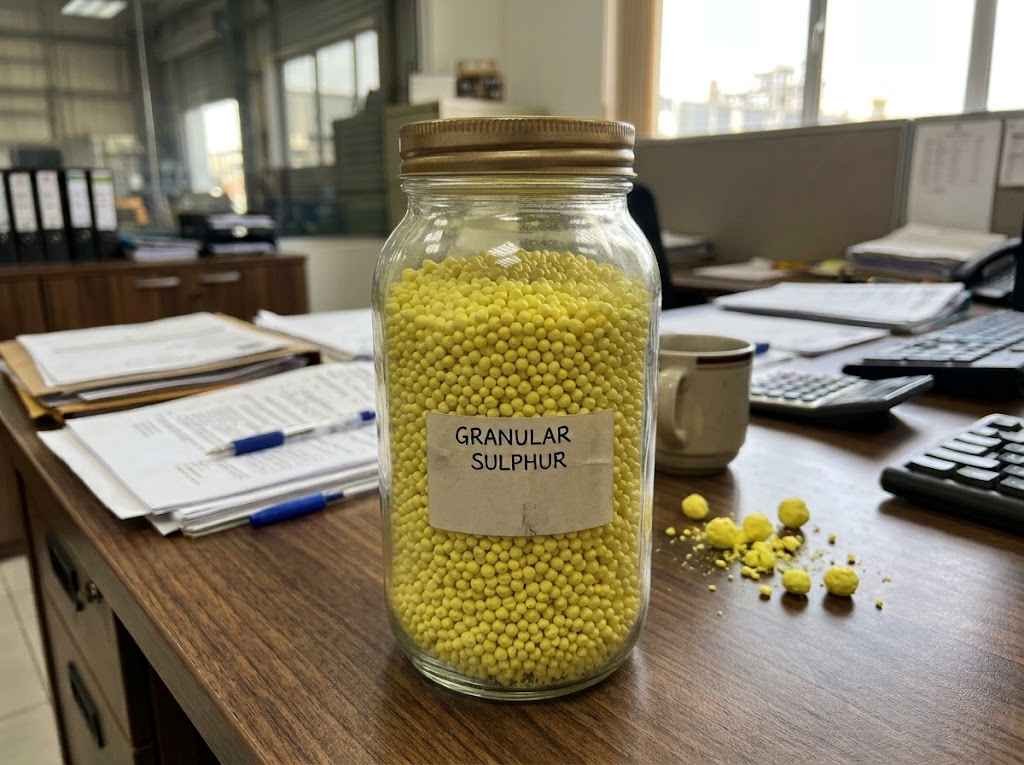
Granular sulphur is a solid form of elemental sulphur produced in relatively uniform granules for easier handling, storage, transportation, and industrial use. It is commonly used as a raw material in several industries. For example, granular sulphur may be used in: fertilizer production; sulphuric acid production; chemical manufacturing; mining and mineral processing; industrial processing; and other sulphur-consuming applications.
However, the required specification depends on the buyer’s end use. Therefore, purchasers should not assume that all granular sulphur products are technically identical.

For additional industry information on sulphur handling, safety, and industrial practices, buyers can also review resources published by The Sulphur Institute (TSI).
A professional granular sulphur supplier should provide technical information relevant to the offered material.
Depending on the application, buyers may check: sulphur purity; moisture; ash content; acidity; particle size; granule uniformity; colour; contamination; and other specified properties. However, not every buyer requires the same limits. For this reason, the purchaser should provide either a target specification or a previously accepted Certificate of Analysis.
Purity is one of the most important parameters when purchasing granular sulphur. Industrial buyers may require high-purity elemental sulphur because impurities can affect downstream processing. However, the required purity level should be defined by the actual application. Therefore, buyers should avoid requesting only: “High-purity sulphur.” A better inquiry would state a clear minimum sulphur content or attach the required specification.
Moisture is another parameter buyers may want to control.
Excessive moisture can affect handling, storage, flow characteristics, and commercial weight.
Therefore, the acceptable moisture limit should be defined in the specification when it is important to the buyer. In addition, storage and transportation conditions can influence the final condition of the cargo.

Granular sulphur is valued partly because its physical form can make bulk handling easier. However, granule size and uniformity may vary between sources. Depending on the industrial process, buyers may care about: average granule size; percentage of fines; oversized material; dust level; and overall particle distribution.
Therefore, a buyer using automated conveying or feeding systems should confirm whether the offered product suits the equipment.
Fine particles can create practical handling issues. For example, excessive fines may increase: dust generation; material loss; housekeeping requirements; and handling difficulty. Therefore, buyers should review the physical condition of the product, not only its chemical purity. Moreover, suitable loading and handling procedures can help reduce product degradation during transport.
Sulphur can be traded in different physical forms. Granular sulphur consists of relatively uniform particles designed for easier handling. By contrast, lump sulphur may contain larger and more irregular pieces. Therefore, granular material may be preferred when the buyer requires: more uniform handling;easier conveying;controlled feeding;or better loading characteristics. However, the most suitable form depends on the buyer’s process and equipment.
Granular sulphur and prilled sulphur are both solid forms of elemental sulphur, but they are produced using different forming processes.
As a result, their shape, particle characteristics, and handling behaviour may differ.
Some buyers specifically require granules, while others accept prills.
Therefore, the required physical form should be clearly stated in the RFQ.
Sulphur plays an important role in the fertilizer industry.
For example, it is used in processes related to sulphuric acid and phosphate fertilizer production.
Therefore, fertilizer manufacturers may purchase sulphur as an industrial feedstock rather than as a finished agricultural product.
These buyers often focus on:
As a result, long-term supply planning can be particularly important for large fertilizer plants.
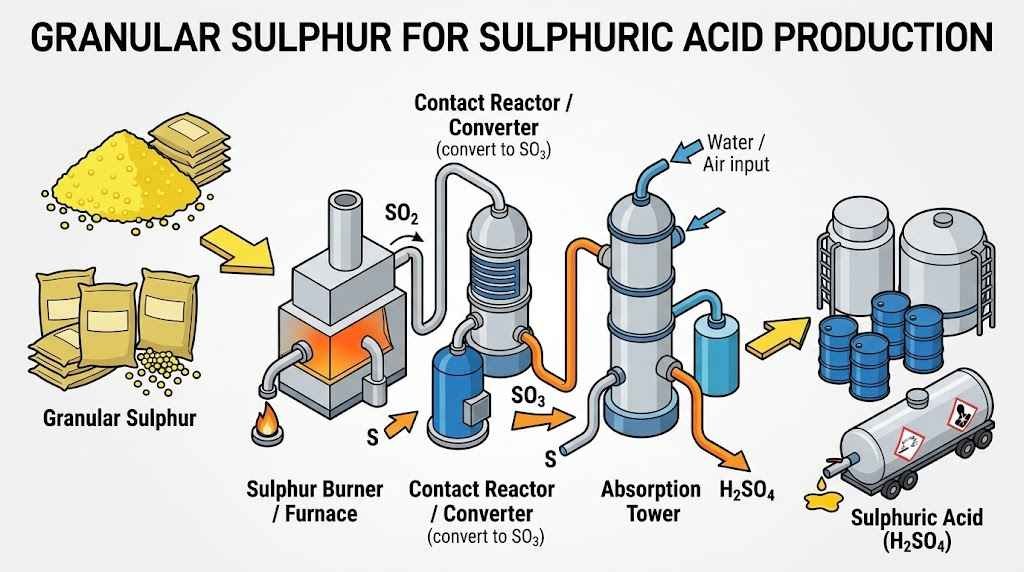
Sulphuric acid is one of the major industrial uses of elemental sulphur. In this application, buyers may require reliable and consistent feedstock for continuous production. Therefore, important purchasing considerations may include: sulphur purity; contamination;handling characteristics;storage;shipment frequency;and supply continuity.
Moreover, industrial plants should ensure that the material meets their process requirements before confirming large-volume purchases.
Different industrial buyers may have different priorities.
For example, one buyer may focus heavily on purity, while another may care more about granule size and handling.
Therefore, the supplier needs to understand the final application before recommending a supply option.
This is why a useful RFQ should include both technical and commercial information.
A Certificate of Analysis, or COA, is an important technical document in sulphur transactions. Depending on the product, it may include: sulphur content;moisture;ash;acidity;physical appearance;and other specified parameters. However, buyers should compare the COA against their own required specification. A certificate is only useful when the tested parameters are relevant to the intended application.
For larger transactions, buyers may request third-party inspection.
Depending on the contract, inspection may include: sampling; laboratory analysis; quantity verification; visual inspection; loading supervision; and document verification.
Moreover, the inspection scope should be agreed before loading. This helps both parties understand how product acceptance will be determined.
Granular sulphur can be supplied in different packaging formats depending on the source, volume, route, and buyer requirement. Possible options may include: bulk; jumbo bags; or other agreed packaging. However, packaging availability should always be confirmed before the buyer relies on a particular format. Therefore, buyers should mention their preferred packaging in the initial inquiry.
Jumbo bags may be suitable for buyers who do not have full bulk-handling infrastructure.
They can simplify storage and distribution in some operations.
However, the buyer should consider:
Therefore, jumbo bags may be practical for some buyers but inefficient for others.
Large industrial buyers often purchase granular sulphur in bulk.
Bulk shipment can be more efficient when:
However, bulk shipment requires more logistics planning than bagged supply.

For this reason, loading port, discharge port, storage capacity, and unloading method should be confirmed early.
Neither option is automatically better. Bulk supply may reduce packaging-related costs for large volumes. By contrast, jumbo bags may offer greater flexibility for smaller industrial buyers or distributors. Therefore, buyers should compare the complete cost of: packaging; loading; ocean freight; unloading; storage; internal handling;and material losses. The lowest ex-supplier price is not always the lowest total procurement cost.
There is no single global price for granular sulphur. Commercial prices may vary according to: sulphur market conditions;purity; physical form;production source; packaging; inland transportation; loading costs; shipment size; freight; destination; payment terms;
Therefore, buyers should compare equivalent offers.
For example: FOB vs FOB or: CFR destination vs CFR destination
provides a more meaningful comparison than comparing unrelated price bases.
A low quotation may look attractive initially.
However, the buyer should also examine:
For example, a cheaper cargo that does not meet the required purity or particle characteristics may create production problems.
Therefore, technical suitability should be checked before final price comparison.
Under an FOB arrangement, the buyer generally arranges the main ocean freight from the agreed loading port according to the applicable Incoterm.
Therefore, an FOB quotation should clearly identify:
Moreover, vessel or container requirements should be understood before the transaction is finalized.
Under CFR terms, the seller arranges the main ocean freight to the named destination port.
Therefore, the buyer should provide the exact discharge port.
For example:
CFR Mundra
is much more useful than:
CFR India
because freight cost depends on the actual route and port.
In addition, shipment volume and vessel availability can materially affect the delivered price.
Under CIF terms, insurance is also arranged according to the applicable Incoterm requirements.
However, buyers should still calculate destination expenses separately.
These may include:
Therefore, CIF should not automatically be considered the final delivered cost to the factory.
Sulphur logistics requires proper planning because shipment size, loading method, storage, and destination facilities can strongly affect the economics of the deal.
Depending on the quantity, transport may involve:
Therefore, the logistics method should be selected according to order size and destination infrastructure.
Tajerin can coordinate shipment requirements with logistics partners where needed.
For large-volume buyers, bulk vessel shipment may offer better economies of scale.
However, the commercial viability depends on:
Therefore, buyers should confirm whether the destination port can efficiently receive bulk sulphur before choosing this option.
Containerized shipment may be suitable for smaller quantities or destinations where bulk infrastructure is not practical.
For example, jumbo bags can be loaded into containers for easier handling at destination.
However, buyers should consider:
As a result, container freight should be evaluated on a per-net-ton basis, not only per container.
Proper storage helps protect product quality and reduces handling problems.
Buyers should consider:
Moreover, sulphur is combustible, so storage and handling should follow applicable industrial and fire-safety procedures.
Therefore, buyers should ensure that their facility is suitable for receiving and storing the material safely.
Large industrial buyers may require repeated or scheduled deliveries rather than a single shipment.
Therefore, they should consider:
A slightly lower spot price may be less important than reliable supply for a continuously operating plant.
As a result, procurement should consider both price and supply security.
Distributors may have different requirements from industrial end users.
For instance, they may focus on:
Therefore, distributors should communicate expected order sizes and preferred packaging before requesting a commercial offer.
Before choosing a granular sulphur supplier, buyers should compare several factors.
Does the offered sulphur meet the required chemical specification?
Is the buyer receiving granular sulphur rather than another form?
Are the granules suitable for the buyer’s handling and production system?
Are the agreed limits acceptable?
Can the supplier provide the required tonnage on schedule?
Can required testing or independent inspection be arranged?
Is the proposed loading and shipping method practical?
Are the delivery and payment terms suitable?
Ultimately, the best offer should combine acceptable quality, reliable quantity, workable logistics, and competitive commercial terms.
Depending on the transaction, buyers may request:
However, the required document list should be agreed before shipment.
This becomes especially important when payment is made through a Letter of Credit.
Payment terms depend on the transaction, quantity, supplier, buyer profile, and commercial conditions.
Possible structures may include:
Nevertheless, payment conditions should be clear before shipment preparation begins.
Moreover, LC document requirements should be reviewed carefully to reduce the risk of discrepancies.
To receive a useful quotation, provide:
For example:
Product: Granular Sulphur
Purity: As per buyer specification
Quantity: 20,000 MT
Packing: Bulk
Destination: Mundra, India
Delivery: CFR
Shipment: December
Inspection: Third-party inspection if required
Payment: LC
With this information, a granular sulphur supplier can prepare a much more meaningful commercial offer.
Before requesting a quotation, make sure you can answer these questions:
If these points are clear, comparing suppliers becomes much easier.
However, if the specification is uncertain, confirm the requirements with the production or technical team before placing an order.
Tajerin operates as a trading and supply company with access to established sources.
For each inquiry, we review:
In addition, Tajerin can coordinate transportation with logistics partners where required.
Our objective is not simply to provide a headline price.
Instead, we aim to provide a commercially workable quotation that the buyer can compare with other available options.
Send your purity requirement, particle-size requirement, quantity, packaging, destination, shipment period, and preferred delivery term.
It is commonly used as an industrial raw material in fertilizer, sulphuric acid, chemical, and other manufacturing processes.
No. Both are solid forms of sulphur, but their production methods and physical characteristics can differ.
Not necessarily. The material should meet the specification required by the buyer’s process.
Yes. Bulk supply is commonly considered for larger industrial volumes where suitable loading, shipping, storage, and unloading infrastructure is available.
Depending on source and commercial conditions, jumbo-bag supply may be available.
Depending on the source, destination, shipment size, and logistics conditions, Tajerin can review different delivery structures.
Yes. Inspection and testing requirements can be agreed before shipment.
If you are looking for a granular sulphur supplier, send Tajerin your technical and commercial requirement.
At minimum, provide:
Purity + Quantity + Physical Requirement + Packaging + Destination + Delivery Term