
Address:
Etesami St, Ziba Shahr, Bandar Abbas
Whatsapp:
Email:
info@tajerin.com
Tajerin is a limestone supplier serving cement plants, construction companies, industrial buyers, distributors, and bulk importers.
However, buying limestone is not only about asking for a price per metric ton. Buyers should first confirm the required chemical composition, CaCO3 content, size, moisture, quantity, application, destination, and delivery term.
Therefore, a clear specification helps suppliers prepare quotations that are easier to compare.
Tajerin works with established supply sources and can review each inquiry according to the required quality, quantity, size, destination, shipment schedule, and commercial conditions.
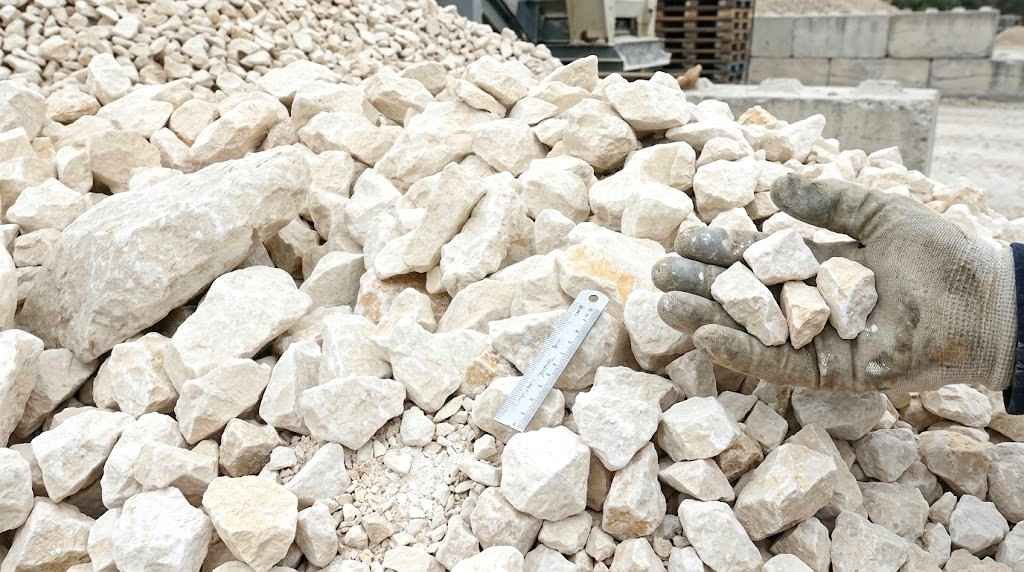
Send us your limestone specification, required size, quantity and destination. Get a quotation from Tajerin, compare it with your other options, and choose the commercial terms that work best for your business.
Limestone is a natural sedimentary rock composed mainly of calcium carbonate.
It is widely used as a raw material in construction and industrial processes.
For example, limestone is commonly used in:
However, limestone quality varies significantly between deposits.
Therefore, buyers should evaluate the material according to the intended application rather than purchasing only by appearance.
A professional limestone supplier should provide technical information relevant to the buyer’s intended use.
Depending on the application, buyers may check:
However, no single limestone specification is suitable for every industry.
For this reason, buyers should provide a target specification or an acceptable previous Certificate of Analysis.
Calcium carbonate, commonly written as CaCO3, is one of the most important components considered by many limestone buyers.
However, the required CaCO3 level depends on the final use.
For example, a cement plant may accept a different limestone specification from a buyer using the material in a high-purity industrial process.
Therefore, buyers should avoid simply requesting:
“High-quality limestone.”
A better inquiry should include the required chemical limits.
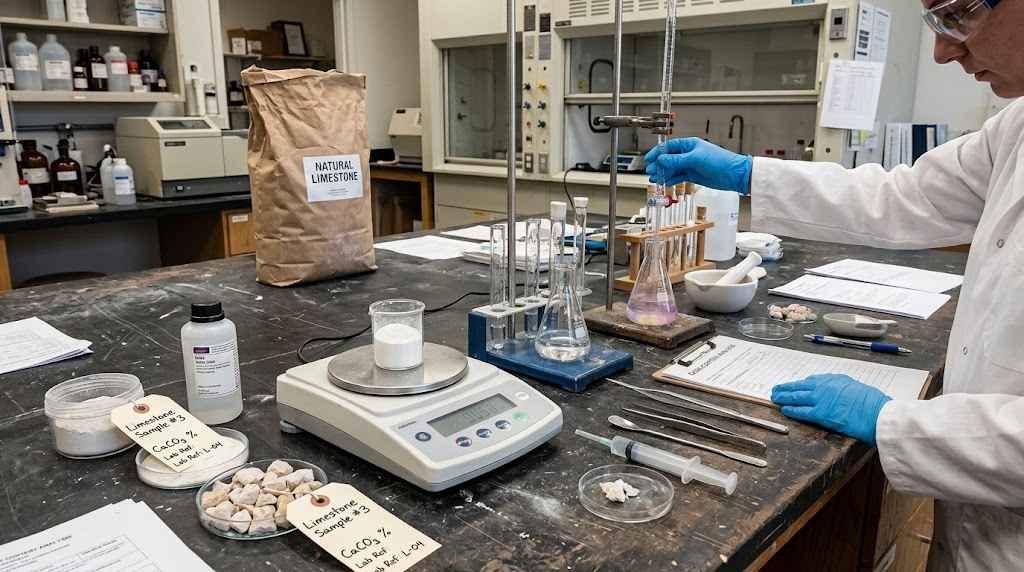
Some buyers evaluate limestone based on CaO and related chemical values rather than only CaCO3.
In addition, they may set limits for:
Therefore, the complete chemical requirement should be reviewed before an offer is accepted.
This becomes especially important for industrial processes where raw-material consistency directly affects production.
Purity can influence how limestone performs in different applications.
For example, excessive impurities may affect:
Therefore, buyers should define which impurities matter for their process.
At the same time, higher purity does not automatically mean that the material is the best choice for every application.
The correct specification depends on the end use.
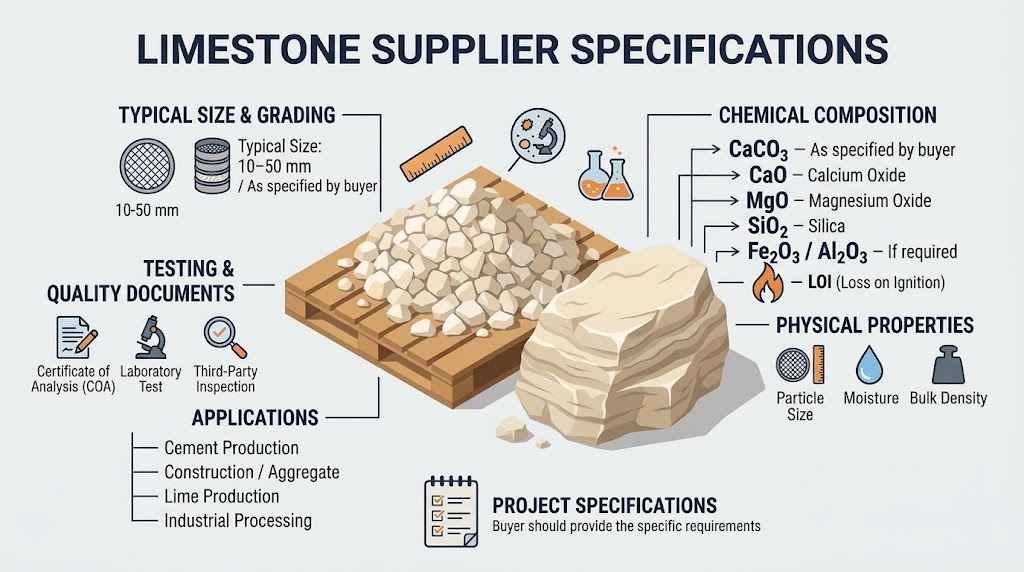
Limestone can be supplied in different sizes.
Depending on the buyer’s requirements, it may be available as:
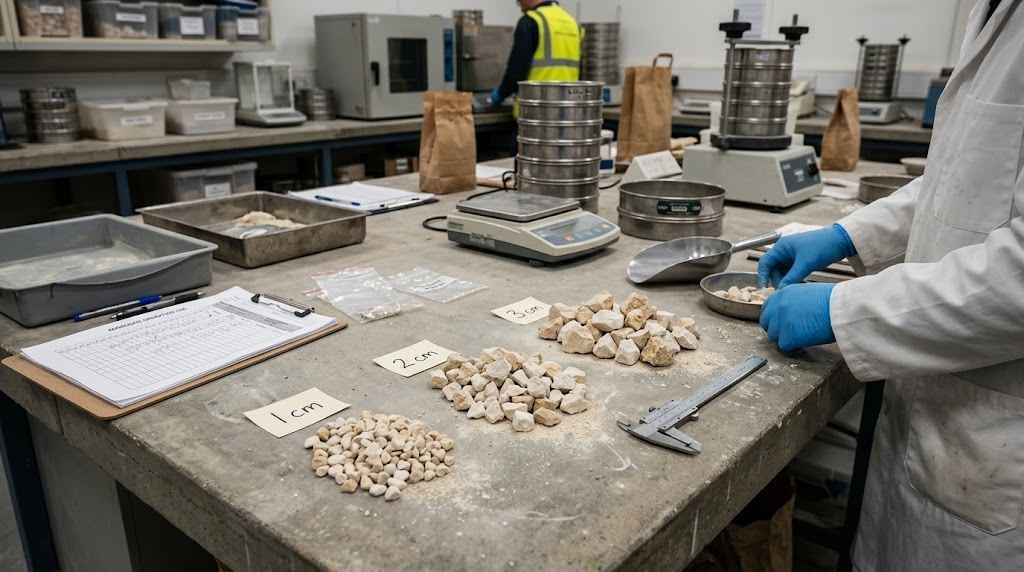
However, size should be defined clearly.
For example:
10–50 mm
is much more useful than:
“Medium size limestone.”
Therefore, buyers should specify minimum and maximum particle size whenever possible.
Some industrial buyers require limestone in lump form.
This may be suitable for certain kilns, crushing plants, processing facilities, or industrial applications.
However, buyers should confirm:
Therefore, physical specification can be just as important as chemical composition.
Crushed limestone is widely used in construction and industrial applications.
Depending on the buyer’s requirement, crushed material may be used for:
However, crushed limestone should be ordered according to an agreed grading.
This helps the buyer avoid receiving too much fine or oversized material.
Limestone is a major raw material in the production of Portland cement and should be selected according to the cement plant’s raw-mix requirements.
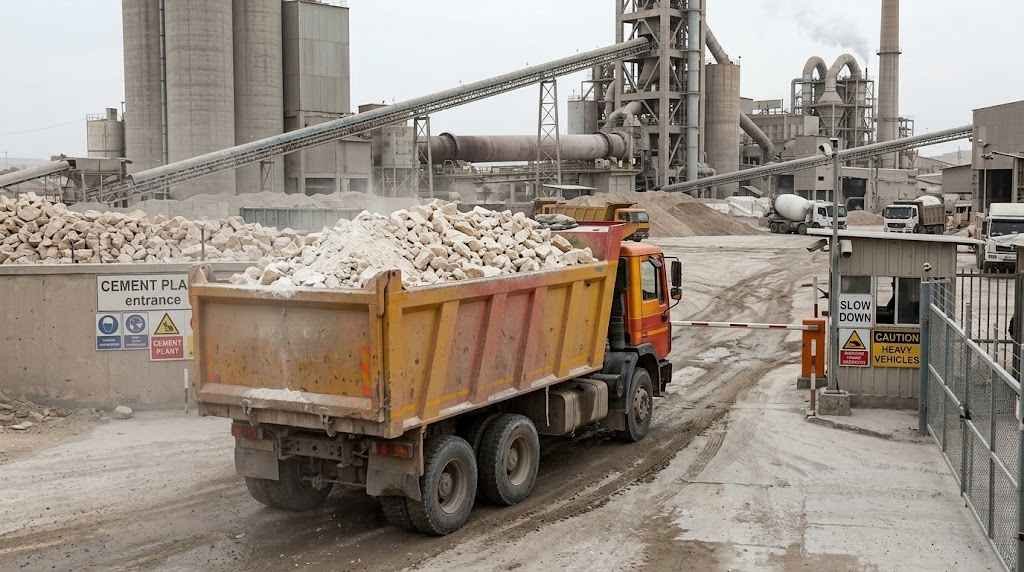
For cement plants, chemical consistency is particularly important because limestone contributes significantly to raw-mix design. After raw-material processing and kiln production, cement manufacturers produce cement clinker before final cement grinding. Cement production also depends on other mineral inputs. Buyers sourcing gypsum stone for cement manufacturing can review Tajerin’s dedicated supply page.
Therefore, cement producers may evaluate:
In addition, the plant may have specific requirements based on its existing raw materials.
For this reason, buyers should send the target chemical specification before requesting a quotation.
A limestone supplier serving cement plants should understand that supply consistency can be as important as initial sample quality.
A single acceptable sample does not guarantee that every future shipment will perform in the same way.
Therefore, larger buyers may request regular analysis and quality control.
Moreover, cement plants may require substantial monthly volumes.
As a result, supply capacity and logistics should be reviewed alongside technical quality.
Limestone is also used as a raw material for producing quicklime and hydrated lime.
In this application, chemical composition and kiln performance can be important.
For example, buyers may focus on:
Therefore, limestone intended for lime production should be evaluated according to the specific kiln and process requirements.
Construction buyers may use limestone in several forms.
For instance, it can be used as:
However, the required properties differ from industrial chemical applications.
Therefore, buyers should clarify whether they need limestone for structural, road, decorative, or general construction purposes.
For additional technical information about limestone and its industrial uses, buyers can review resources published by the U.S. Geological Survey (USGS).
Road projects may require limestone in controlled gradations.

Depending on the project, the buyer may care about:
Therefore, a road-construction inquiry should include the applicable project specification.
This is more useful than asking only for a general limestone quotation.
Industrial limestone requirements can vary greatly.
For example, limestone may be used in:
However, each process may require different chemical and physical properties.
Therefore, industrial buyers should provide detailed technical requirements before selecting a source.
Colour may be important in certain applications.
For example, buyers using limestone in decorative or filler applications may care more about colour consistency.
By contrast, cement or road-construction buyers may focus mainly on chemical and physical performance.
Therefore, appearance should be treated as an application-specific requirement.
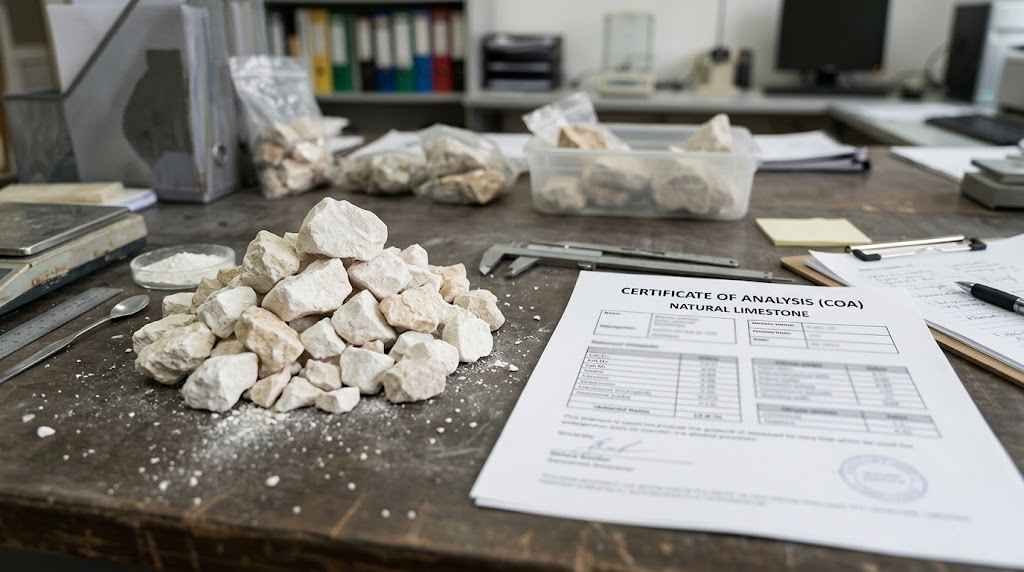
A Certificate of Analysis, or COA, helps the buyer understand the chemical characteristics of the material.
Depending on the application, it may include:
However, buyers should compare the COA against their own required specification.
A certificate is useful only when the tested parameters are relevant to the buyer’s process.
For larger orders, buyers may request third-party inspection or laboratory testing.
Depending on the contract, inspection may cover:
Moreover, sampling procedures should be agreed before loading.
This helps reduce disputes about whether a sample truly represents the full cargo.
Limestone is often traded in substantial volumes.
Large industrial buyers may purchase:
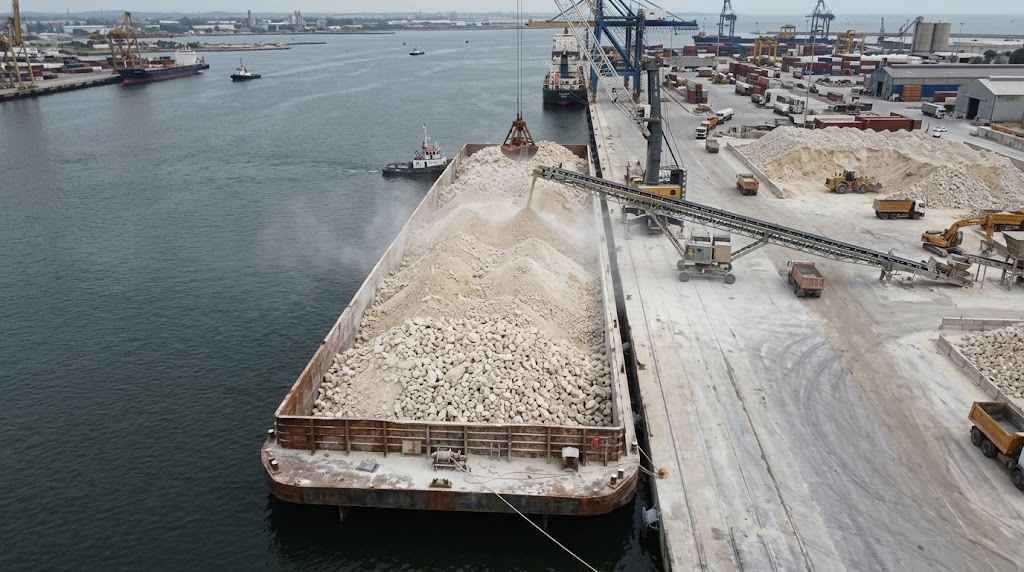
Therefore, bulk supply requires planning around:
For this reason, quantity and required delivery period should always be included in the inquiry.
Packaging depends heavily on size, quantity, and application.
Possible supply formats may include:
However, large-volume limestone transactions are often more practical in bulk.
Therefore, the buyer should select packaging based on handling equipment and destination infrastructure.
Bulk material may be more economical for large industrial volumes.
By contrast, bagged material may be more practical for smaller buyers or specialized applications.
Therefore, buyers should compare the complete cost of:
A lower packaging cost does not automatically mean a lower total landed cost.
There is no single global limestone price.
Commercial pricing may depend on:
Therefore, buyers should compare quotations on the same commercial basis.
For example:
FOB vs FOB
or:
CFR destination vs CFR destination
provides a more meaningful comparison.
A low quarry price may initially look attractive.
However, the material may involve:
As a result, a slightly higher-priced source may offer better overall economics.
Therefore, buyers should evaluate both technical suitability and total landed cost.
Under an FOB structure, the buyer usually arranges the main ocean freight from the agreed loading port according to the applicable Incoterm.
Therefore, an FOB quotation should identify:
Moreover, bulk loading terms may significantly affect total shipping cost.
Under CFR terms, the seller arranges the main ocean freight to the named destination port.
Therefore, the exact discharge port should be provided.
For example:
CFR Chittagong
is more useful than:
CFR Bangladesh
because freight depends on the actual port and shipping route.
In addition, cargo size can materially affect freight economics.
Under CIF terms, insurance is also arranged according to the applicable Incoterm requirements.
However, destination costs still need to be reviewed separately.
These may include:
Therefore, a CIF quotation should not automatically be treated as the final delivered cost to the buyer’s plant.
Limestone is a relatively heavy bulk commodity.
Therefore, logistics can represent a significant part of the final landed cost.
Depending on shipment size, transportation may involve:
As a result, the best logistics option depends on quantity and destination.
Tajerin can coordinate transportation requirements with logistics partners where needed.
For large-volume orders, vessel shipment may provide better freight economics.
However, the feasibility depends on:
Therefore, buyers planning vessel-sized orders should provide expected shipment quantity early in the discussion.
Containers may be suitable for smaller orders or destinations where bulk-vessel shipment is impractical.
However, limestone is dense and heavy.
Therefore, buyers should consider:
As a result, containerized limestone should be evaluated based on total cost per delivered metric ton.
Loading method depends on product size and shipment format.
For example, equipment may include:
However, the receiving facility should also be prepared for unloading.
Therefore, buyers should confirm both loading and discharge capabilities before choosing a shipment method.
Moisture can affect both product condition and commercial weight.
In some applications, moisture may also influence handling or processing.
Therefore, buyers should define any important moisture limits in the specification.
Moreover, weighing methodology should be clear when large quantities are involved.
Before choosing a limestone supplier, buyers should compare more than price.
Does the material meet the required CaCO3, CaO, MgO, silica, and impurity limits?
Is the particle-size range suitable for the buyer’s equipment or application?
Can the source maintain similar quality over repeated shipments?
Can the required tonnage be supplied within the required period?
Can sampling and testing be arranged if needed?
Can the cargo be transported efficiently to the destination?
Can the required technical and shipping documents be provided?
Are the delivery and payment conditions workable?
Ultimately, the best source should combine suitable quality, sufficient quantity, practical logistics, and competitive commercial terms.
Depending on the transaction, buyers may require:
However, the required document list should be agreed before shipment.
This becomes especially important when payment is arranged through a Letter of Credit.
Payment terms depend on the order size, source, destination, and commercial conditions.
Possible structures may include:
Nevertheless, payment requirements should be clear before production and shipment planning begins.
Moreover, LC document requirements should be reviewed carefully before opening the credit.
To receive a meaningful quotation, buyers should provide:
For example:
Product: Limestone
Application: Cement Production
Chemical Specification: As per attached requirement
Size: 10–50 mm
Quantity: 25,000 MT
Packing: Bulk
Destination: Chittagong, Bangladesh
Delivery: CFR
Shipment: December
Inspection: Third-party inspection if required
Payment: LC
With this information, a limestone supplier can prepare a much more useful quotation.
Before asking for a quotation, make sure you can answer these questions:
If these points are clear, quotations become much easier to compare.
However, if the chemical requirements are uncertain, confirm them with the plant, engineer, consultant, or technical department before ordering.
Tajerin operates as a trading and supply company with access to established limestone sources.
For each inquiry, we review:
In addition, Tajerin can coordinate transportation with logistics partners where required.
Our objective is not simply to provide a limestone price.
Instead, we aim to prepare a commercially workable offer that the buyer can compare with other available options.
Send the intended application, chemical specification, required size, quantity, destination, packaging, and preferred delivery term.
Limestone is mainly composed of calcium carbonate, although the exact chemical composition varies between deposits.
No. Cement plants should evaluate the chemical composition and consistency of the material before purchasing.
Yes. Depending on source and processing facilities, different lump and crushed sizes may be available.
Yes. Bulk supply is commonly used for larger industrial and construction orders.
Depending on the source, size, quantity, and commercial conditions, bagged options may be reviewed.
Depending on source, destination, quantity, and shipment conditions, Tajerin can review different delivery structures.
Yes. Chemical analysis and other relevant technical information can be reviewed as part of the transaction.
Yes. Sampling, testing, quantity verification, and other inspection requirements can be agreed before shipment.
If you are looking for a limestone supplier, send Tajerin your technical and commercial requirements.
At minimum, provide:
Application + Chemical Specification + Size + Quantity + Destination + Delivery Term