Welcome to Tajerin Trading Company



Address:
Etesami St, Ziba Shahr, Bandar Abbas
Whatsapp:
Email:
info@tajerin.com
Tajerin is a Sulphate Resistant Cement supplier serving contractors, infrastructure projects, marine works, foundation contractors, distributors, and bulk importers.
However, SRC should not be selected simply because it sounds stronger or more durable than ordinary cement. Buyers should first confirm whether the project is actually exposed to sulphate-rich soil, groundwater, seawater, or other aggressive conditions.
Therefore, the first step is to check the project specification, soil report, structural requirements, and applicable cement standard.
Tajerin works with established production sources and can review each inquiry according to the required cement type, strength class, quantity, packaging, destination, shipment schedule, and commercial terms.
Send us your SRC specification, quantity, packaging and destination. Get a quotation from Tajerin, compare it with your other options, and choose the commercial terms that work best for your project.
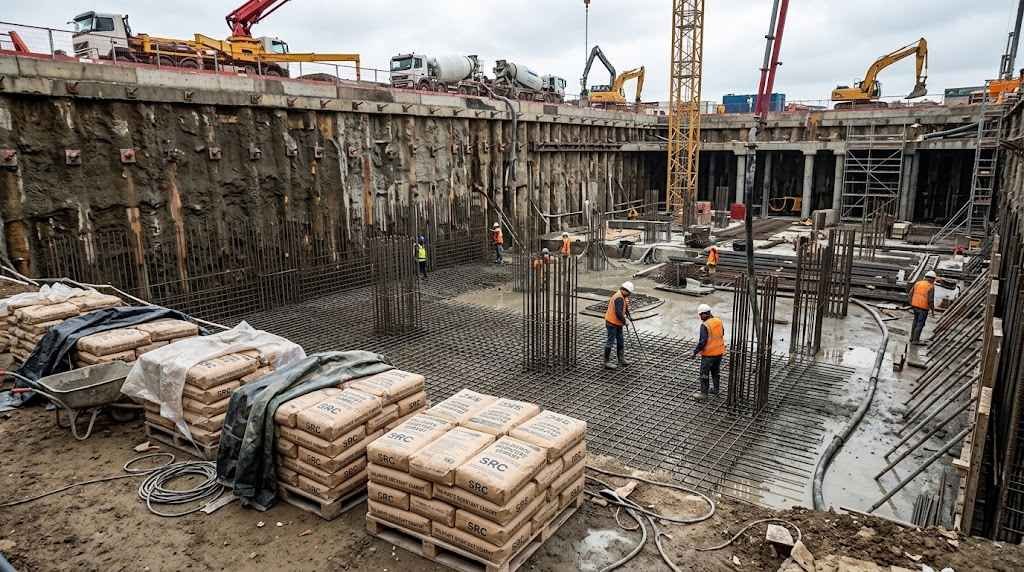
Sulphate Resistant Cement, commonly called SRC, is a cement designed for concrete exposed to sulphate attack.
Sulphates may be present in:
When sulphates react with vulnerable cement compounds, they can contribute to expansion, cracking, and deterioration of concrete.
Therefore, SRC is used where the project specification requires greater resistance to sulphate exposure.
However, the exact cement chemistry and performance requirements depend on the applicable standard.
Buyers working with ASTM-based specifications can also review relevant cement standards published by ASTM International.
Not every construction project needs sulphate-resistant cement.
For example, normal residential or commercial construction in non-aggressive soil may use other approved cement types.
SRC becomes more relevant when the structure is exposed to aggressive sulphate conditions.
Typical applications may include:
Therefore, buyers should follow the engineer’s or consultant’s specification rather than automatically choosing SRC.
A reliable Sulphate Resistant Cement supplier should provide technical information relevant to the required cement standard.
Depending on the applicable specification, buyers may review:
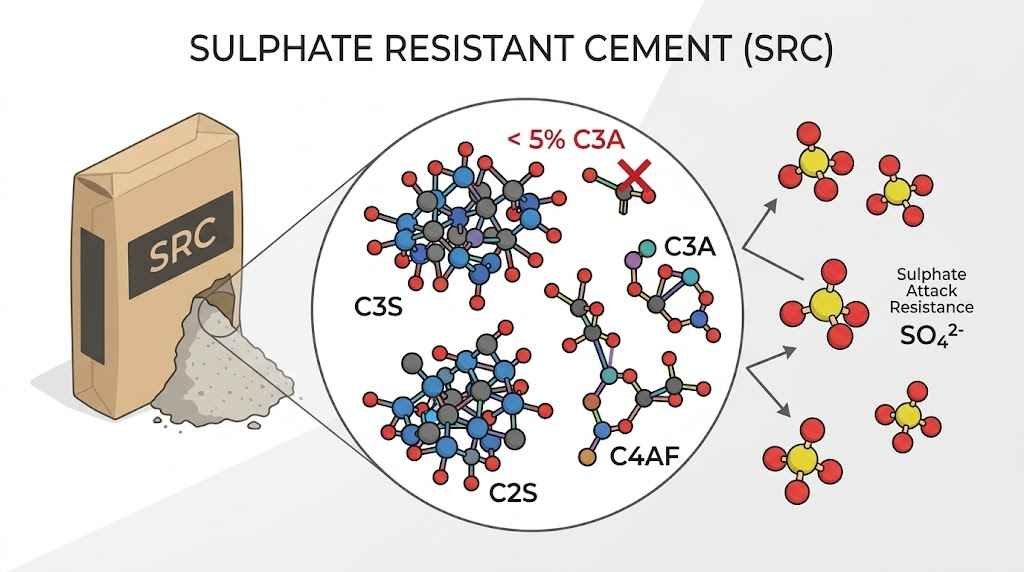
However, not every standard uses exactly the same limits or terminology.
Therefore, the buyer should provide the required standard or project specification before requesting a final commercial offer.
Sulphate attack can damage concrete over time.
In aggressive environments, sulphates can react with cement hydration products and create expansive compounds.
As a result, concrete may experience:
Therefore, choosing the correct cement can be important for long-term performance.
However, cement selection is only one part of sulphate resistance.
Concrete quality also depends on:
For this reason, SRC should be used as part of a complete durability strategy.
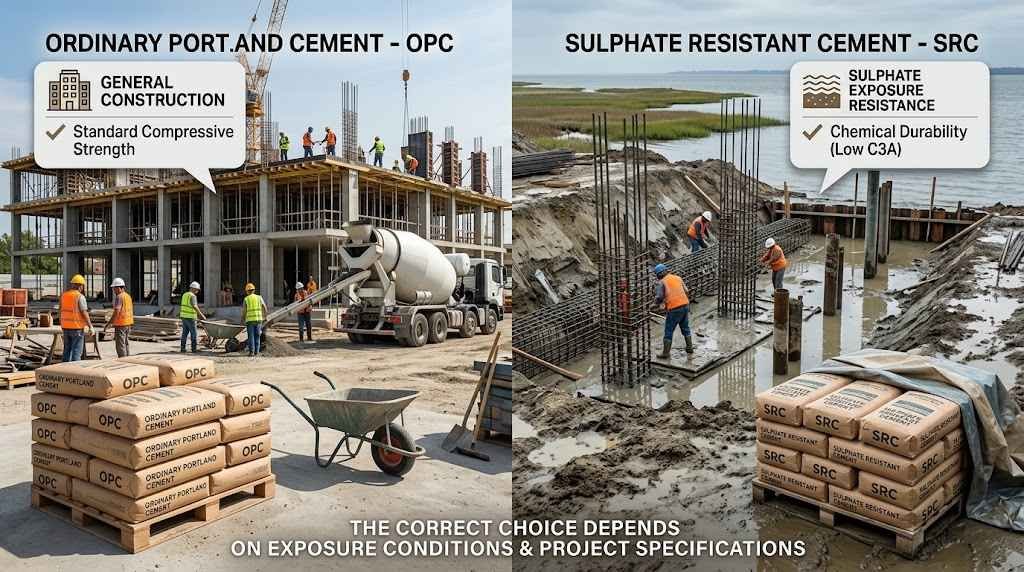
Ordinary Portland Cement is widely used in general construction.
By contrast, SRC is intended for projects where resistance to sulphate exposure is specifically required.
The main difference is not simply “stronger cement.”
Instead, SRC is formulated or controlled to meet particular sulphate-resistance requirements under the applicable standard.
Therefore, a buyer should not compare OPC and SRC only by compressive strength.
The correct choice depends on exposure conditions and project specifications.
Not necessarily.
SRC and OPC may be available in similar strength classes depending on the standard and manufacturer.
Therefore, sulphate resistance and compressive strength should be considered as separate technical requirements.
For example, a project may require:
Sulphate Resistant Cement + specific strength class
rather than simply “high-strength cement.”
This is why the full specification matters.
Marine structures are commonly associated with aggressive environmental exposure.
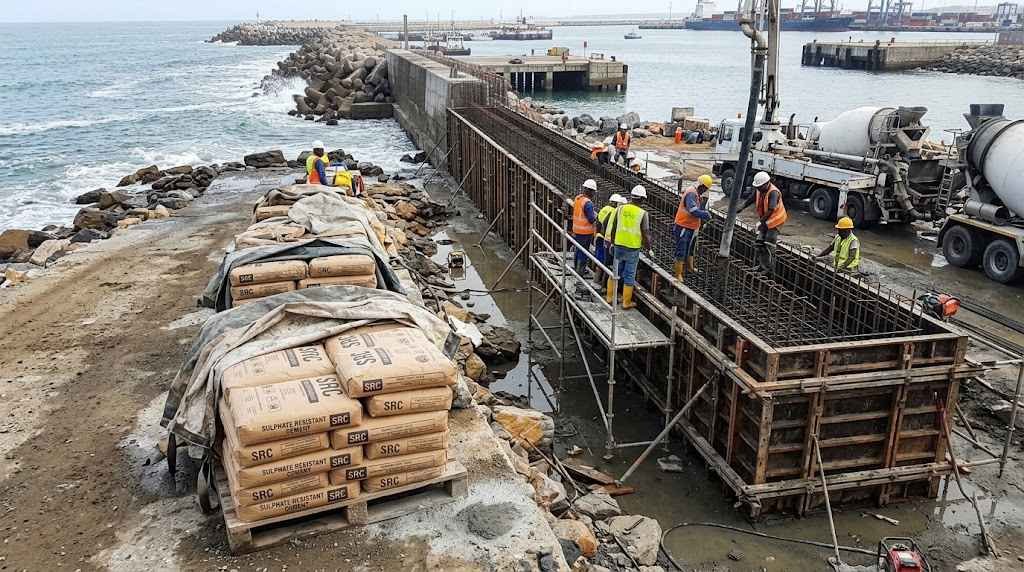
For example, coastal and marine projects may involve:
Therefore, cement selection should follow the project’s durability design.
SRC may be specified for certain marine applications, but the full concrete system should also be considered.
In addition, designers may specify low permeability, adequate cover, suitable admixtures, and proper curing.
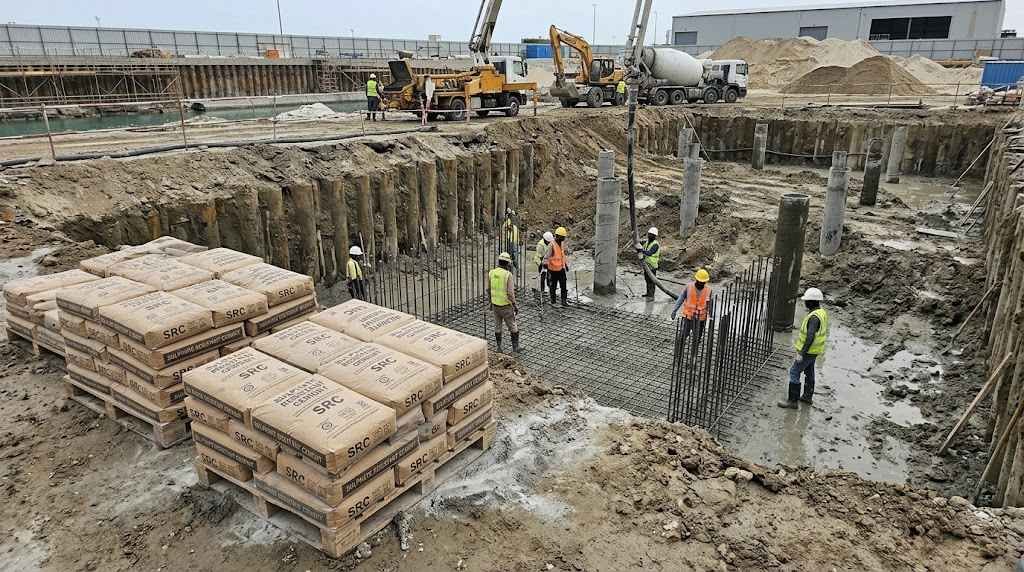
Foundations may be exposed to sulphate-bearing soils or groundwater.
Therefore, geotechnical reports and soil analysis can be important when selecting cement.
Before purchasing SRC for foundation work, buyers should check:
As a result, the supplier can provide a more suitable offer.
Underground concrete can remain in contact with soil and groundwater for long periods.
Therefore, durability requirements may be stricter than for ordinary above-ground structures.
SRC may be specified for:
However, the buyer should still follow the approved engineering specification.
Wastewater and sewage infrastructure may expose concrete to aggressive chemical environments.
For example, structures may experience:
Therefore, cement selection should form part of the overall durability design.
Depending on the project, SRC may be one of the specified materials.
Different markets may use different standards or classifications.
Depending on the project, buyers may encounter:
Therefore, the full standard should be stated in the RFQ.
A request such as:
“Need SRC”
may not provide enough information.
A better inquiry should state the required standard and strength class where possible.
SRC may be available in different strength classes depending on the manufacturer and applicable standard.
Buyers may encounter designations such as:
However, availability varies.
Therefore, buyers should send the exact project requirement rather than assuming every SRC supplier offers every grade.
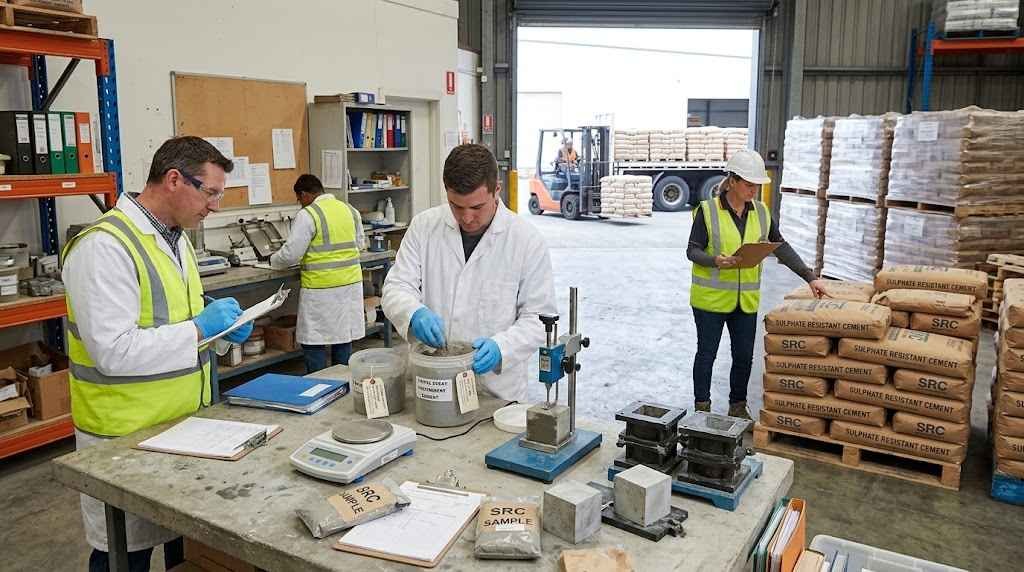
A Certificate of Analysis, or COA, helps buyers review whether the offered cement meets the required technical parameters.
Depending on the applicable standard, the certificate may include:
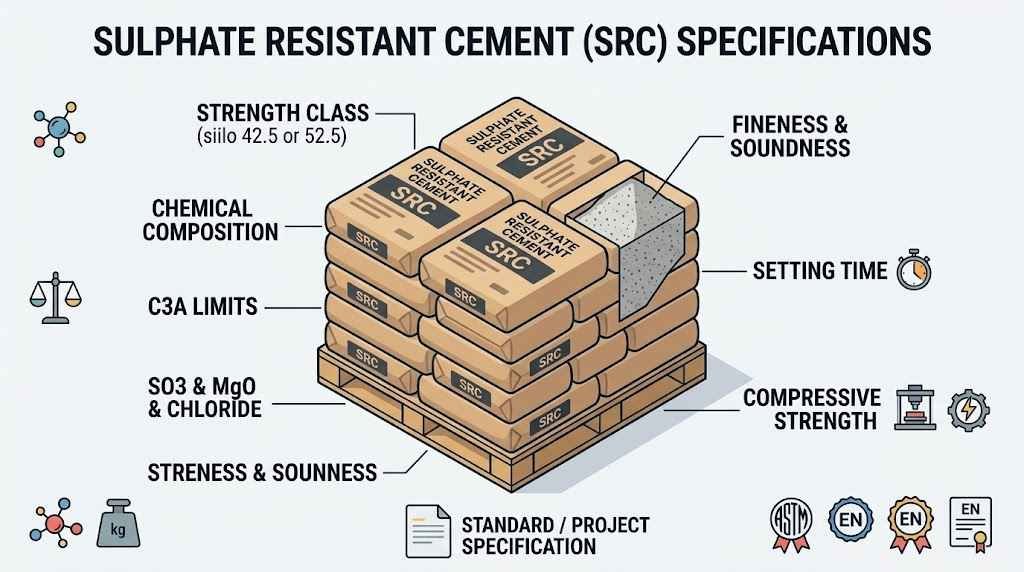
However, the COA should always be checked against the project specification.
A certificate is useful only when the tested parameters are relevant to the buyer’s actual requirements.
Depending on the source, buyers may also receive mill or quality certificates.
These documents may identify:
Therefore, buyers should confirm which documents are required before shipment.
This becomes especially important for consultant-approved projects.
For large or project-based orders, buyers may request third-party inspection.
Depending on the transaction, inspection may include:
Moreover, the inspection scope should be agreed before loading.
This helps reduce disputes about product conformity after shipment.
Bagged SRC may be suitable for contractors, distributors, and project sites without bulk cement infrastructure.
Common bag sizes may include:
However, actual packaging availability depends on the production source.
Therefore, buyers should state the required bag size in the inquiry.
For example:
Packaging: 50 kg bags
is clearer than:
“Need bagged SRC.”

Large projects, ready-mix plants, and industrial buyers may prefer bulk SRC where suitable infrastructure is available.
Bulk cement may be practical when the buyer has:
However, the receiving system must be compatible with the proposed logistics method.
Therefore, bulk supply should be planned before the quotation is finalized.
Bagged cement may be more practical when:
By contrast, bulk supply may be more efficient where:
Therefore, the best packaging depends on operational conditions.
There is no single global SRC price.
The final commercial price may depend on:
Therefore, quotations should be compared on the same basis.
For example:
FOB vs FOB
or:
CFR destination vs CFR destination
provides a more accurate comparison.
A lower price can appear attractive at first.
However, buyers should also review:
For example, a cheaper cement that does not meet the required sulphate-resistance standard is not a real alternative.
Therefore, technical compliance should come before price comparison.
Under an FOB arrangement, the buyer normally arranges the main ocean freight from the agreed loading port.
Therefore, an FOB quotation should clearly identify:
Moreover, loading conditions should be confirmed before the transaction is finalized.
Under CFR terms, the seller arranges the main ocean freight to the named destination port according to the applicable Incoterm.
Therefore, the exact destination should be provided.
For example:
CFR Sohar
is much more useful than:
CFR Oman
because freight depends on the actual port and route.
In addition, shipment quantity may influence freight economics.
Under CIF terms, insurance is also arranged according to the applicable Incoterm requirements.
However, buyers should still evaluate:
Therefore, CIF should not automatically be considered the final delivered cost to the construction site.
Cement logistics can significantly affect the final landed cost.
For bagged SRC, buyers should consider:
For bulk shipments, completely different infrastructure may be required.
Therefore, the logistics method should match the buyer’s actual receiving capability.
Tajerin can coordinate transportation requirements with logistics partners where needed.
Cement must be protected from moisture.
If water reaches the material, premature hydration and lump formation may occur.
Therefore, buyers should pay attention to:
In addition, damaged bags should be identified and handled appropriately.
Bagged SRC should be stored in dry conditions.
Where possible, buyers should:
Moreover, older cement may perform differently depending on storage conditions.
Therefore, procurement quantities should match realistic site consumption.
Contractors should confirm that SRC is actually required by the approved project documents.
Before ordering, they should check:
Therefore, purchasing should follow the project specification rather than assumptions.
Infrastructure projects may require strict documentation and approval procedures.
For example, buyers may need:
Therefore, these requirements should be communicated during the quotation stage.
This can prevent delays after the purchase order is issued.
Ready-mix producers may use SRC when supplying concrete to projects with specific durability requirements.
Therefore, they may focus on:
In addition, regular availability may matter more than a small difference in unit price.
For these buyers, continuity and technical consistency are especially important.
Before selecting a Sulphate Resistant Cement supplier, buyers should compare several factors.
Is the product actually suitable for the specified sulphate-resistance requirement?
Does it comply with the project or destination standard?
Is the correct strength category being offered?
Can the supplier provide a relevant COA or quality certificate?
Can the required volume be supplied within the project schedule?
Does the packaging match the site or distribution requirement?
Can third-party inspection be arranged if required?
Is the proposed shipment method workable?
Are the payment and delivery conditions suitable?
Ultimately, the best offer combines technical compliance, dependable supply, practical logistics, and competitive commercial terms.
Depending on the project and destination, buyers may require:
However, the complete document list should be agreed before shipment.
This is especially important when payment is made through a Letter of Credit.
Payment terms depend on the transaction, quantity, destination, and commercial conditions.
Possible arrangements may include:
Nevertheless, payment requirements should be confirmed before shipment planning begins.
Moreover, LC terms should be reviewed carefully so that the requested documents match what can actually be provided.
To receive a useful quotation, buyers should provide:
For example:
Product: Sulphate Resistant Cement
Strength Class: As per project requirement
Standard: As specified by buyer
Quantity: 8,000 MT
Packaging: 50 kg bags
Destination: Sohar, Oman
Delivery: CFR
Shipment: December
Inspection: Third-party if required
Payment: LC
With this information, a Sulphate Resistant Cement supplier can prepare a much more accurate commercial offer.
Before requesting a quotation, make sure you can answer these questions:
If these points are clear, quotations become much easier to compare.
However, if the need for SRC is uncertain, confirm it with the project engineer, consultant, geotechnical report, or concrete specification before ordering.
Tajerin operates as a trading and supply company with access to established cement production sources.
For each inquiry, we review:
In addition, Tajerin can coordinate transportation with logistics partners where required.
Our objective is not simply to quote a price per ton.
Instead, we aim to prepare a commercially workable offer that buyers can compare with other available options.
SRC is used in projects where concrete may be exposed to significant sulphate conditions, such as certain foundations, marine works, underground structures, and wastewater facilities.
Not generally. SRC is intended for specific exposure conditions. The correct cement depends on the project specification.
No. The requirement depends on soil, groundwater, engineering design, and applicable standards.
It may be specified for certain marine projects. However, marine durability also depends on other factors such as permeability, chloride exposure, concrete quality, and curing.
Depending on the production source, 50 kg bags may be available.
Yes, where suitable loading, transportation, storage, and receiving facilities are available.
Depending on source, destination, quantity, and shipment conditions, Tajerin can review different delivery structures.
Yes. Inspection and testing requirements can be agreed before shipment.
Typical requirements may include a Certificate of Analysis, Certificate of Origin, commercial documents, and other project-specific certificates.
If you are looking for a Sulphate Resistant Cement supplier, send Tajerin your complete technical and commercial requirement.
At minimum, provide:
SRC Specification + Standard + Strength Class + Quantity + Packaging + Destination + Delivery Term